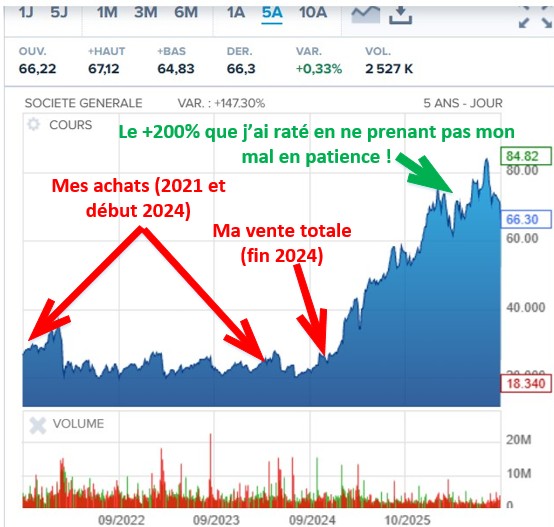
The rats (foreigners?) are leaving the ship France, it seems

Most of you don’t practice stock picking and that’s a good practice. But for those, probably the older ones (or at least those who have been investing for a long time) who still have a certain number of French stock positions in their PEA, how are you experiencing the slow decline of recent times?

I’m dismayed to see every evening the CAC and SBF 120 falling inexorably, much more than other European stock markets. Yet, the fundamentals of our large companies, many of which are among the world leaders, are not in question. It’s the France ship, guided by appalling politicians, that is causing fear.

How are you reacting to this for your French positions in the PEA? Are you selling all or part of your positions, telling yourself that this will last at least another year (being very optimistic…)? Are you planning to buy back when it has fallen significantly? Are you holding on and consoling yourself with the upcoming dividends?

Personally, I’ve dumped everything over the past few weeks, except Total, Danone, and Orange (resilient stocks). I was tired of seeing my other stocks stagnate for 3 years.

The CAC 40 drops easily and recovers little. Since I had invested rather poorly in individual stocks, I must have been at 9% gains over 3 years—frankly, that’s not enough, it’s a huge opportunity cost, hence my decision to sell everything, which really hurts when you’re selling Stellantis or LVMH at a massive loss :grin: but in the short term I seem to have been right because it’s only gotten worse.

In my PEA, I’ve put 60% world, 20% Europe 50 (just because), 10% stocks, 10% cash.

If the fundamentals aren’t deteriorating, why sell?

I can understand taking profits

Selling at a loss or because the future is uncertain is surprising

No, I think on the contrary that it’s smart. Leaving capital in assets that stagnate for too long waiting for them to recover makes you lose growth potential on other more dynamic assets.

I agree with Renaud, at some point you have to know when to cut your losses. 3 years of stagnation is 3 years where that capital could have earned more on other securities.

I did the same with my infected life insurance policy at Caisse d’Épargne. I preferred to close the policy and take a loss of €250 on my €12,000 despite the promise of 4% per year at the end of 10 years. OK, I’m giving up €4,800 in capital gains, €250 in losses, and my tax seniority. But in return, better invested, this capital could earn me €8,600 in capital gains if placed in an ETF for 8 years.

3 Likes

What is the relationship between dollar-cost averaging and stock picking?

Either you believe in the stocks you’ve selected and you wait if the fundamentals are still good according to your analysis, or you cut your position if they deteriorate

In theory, if you invest in a company it’s not short-term… you can stagnate for 3 years and make 100% over the following 2 years, you need to zoom out

1 Like

Because achieving 233.33% in 10 years for Stellantis just to recover the invested capital is possible, but I find it hard to believe. Moreover, they cut the dividend, which creates permanent unrealized losses with no return. Here, it fits your description of a sector in major crisis.

For others with much smaller losses, it’s indeed the opportunity cost as Fred mentioned. Take LVMH for example, it’s very likely to return to €700 someday, it’s a good company, I had to sell it around €480 because I was tired of waiting for it to regain weight in China. On paper, I therefore lost €150 per share, but in reality with the recent drop, I preserved €100 that will work better elsewhere.

And if the dynamics change, there will always be time to buy back at a bargain price. What you have in unrealized losses is actually already lost, it’s like a neutral operation on your capital if you sell at time T. The market couldn’t care less about the price at which you bought the stock. At time T, the value of your position is what it is on the screen.

It’s a bit like if you take over a struggling business, you’re not going to keep the same elements and ways of operating while waiting for it to produce different results, telling yourself well since there are many of them and we pay them dearly it will produce more results. Either you transform the textile factory you just bought and its employees into something where there’s demand and opportunities, or you reduce all costs until you give it a size that corresponds at minimum to what it generates in profit. It’s the price of time that matters.

Time works against you, if you don’t do it, eventually you’ll just sink, regardless of the funding you put into it or the quality of the products you make. That’s the example of Duralex, Brandt or to be even more telling, Nike today, it’s an excellent brand, I have some myself but in terms of market, it’s been doing nothing but declining for 5 years. And I don’t think paying someone who’s supposed to work for us but costs us money and mental resources every year is a good idea.

For Duralex, there’s also the energy cost as a problem since running mega-furnaces with crazy rates isn’t viable. As with Stellantis and so many others, they will have been killed by policies or government regulations on energy. Another heart of the economy.

1 Like

It’s all about the balance between believing it will bounce back and waiting, or deciding to accept the loss and immediately take advantage of the momentum in other stocks.

I don’t believe that a company whose stock is falling has a higher potential for recovery than another company. I believe it has simply lost part of its value in the financial market, that’s all. For its future growth, the game starts over—investing, restoring confidence… So I don’t see why you should wait to recover your gains on this one, especially if growth is sluggish. You might as well redirect the capital to more attractive stocks.

2 Likes

Are we in the context of a PEA that guarantees you that a stock will perform better than the one you hold at a loss?

We come back to buying stocks, LVMH is a superb company but in my opinion 700 € was a price that was far too high in relation to its fundamentals and still from my point of view if I had bought at 700 € believing that the price was coherent at less than 400 € today I would have doubled my position. To finish on this stock what was the price of LVMH 10 years ago?

Why only take as examples companies like Duralex, Brandt, Nike, Stellantis? We can add Alstom, Orpea, Casino…

There are also companies like Nvidia, Safran, Schneider, Air Liquide, Total.

If indeed all the selected stocks and therefore the portfolio stagnate while the market is bullish over 3 years, you need to stop stock picking quite simply

@Frederic364 I never wrote that a stock that falls has a better chance of outperforming another. I don’t read the future however I say that having bought a stock with excellent fundamentals there is no reason to change strategy in the short term even if its price is volatile.

Are we in the context of a PEA that guarantees you that a stock will perform better than the one you hold at a loss?

Nothing, but it’s like a new love story, you want to believe in it more than the previous one because you have more experience.

We come back to buying stocks, LVMH is a superb company but in my opinion 700 € was a much too high price in relation to its fundamentals and still in my view if I had bought at 700 € believing the price was coherent at less than 400 € today I would have doubled my position.

That’s coherent, but luxury is one of the sectors in which I have the least investment and therefore doesn’t really interest me. So it’s quite easy not to renew the confidence or a thesis.

Why only take as examples companies like Duralex, Brandt, Nike, Stellantis? We could add Alstom, Orpea, Casino…

I still love them :grin: we could have talked about SEB which relocated its low-profitability tasks to keep only those with high added value in France in order to survive French labor or energy costs.

There are also companies like NVIDIA, Safran, Schneider, Air Liquide, Total.

Yes I have some.

If indeed all the selected stocks and consequently the portfolio stagnate while the market is bullish over 3 years, stock picking should simply be stopped

This egotistical sentence has no place in a discussion between quality people.

My husband has his PEA under discretionary management with a large French bank, invested 100% in stock picking. He discovered that his manager, a few weeks ago, sold three-quarters of the PEA (the French stock positions) to buy shares from other European countries. Instructive, I find… and as it happens, it was a good idea financially. Many people on this forum criticize discretionary management, but this proves that it’s not always a bad idea.
As for me, being attached to my French company holdings (too much?), I suffered more from the Paris stock market decline.
I’ve lightened certain positions somewhat recently, to reinvest in more general ETFs and reduce the proportion of stock picking (about 60% today, but I started from 100%). This is what I’ve been doing for several years (since the gradual arrival of ETFs on the PEA), forcing myself to do so, actually. The recent sales, added to those from the past year, have allowed me to:

  • reduce the number of positions (only 13 left!).
  • bring several average purchase prices into negative territory (= a good moment in an investor’s life).
  • see positions with heavy losses disappear (Stellantis, Capgemini). It’s psychologically satisfying, I find… but the worst loss (LVMH: -€5,500) is still there, unfortunately (catastrophic purchase timing, close to the peak).
  • lighten the amount of several remaining positions in favor of more diversified ETFs.

When I sell my large Air Liquide position, I’ll be able to claim I’m definitively cured of my stock picking « addiction. » But that probably won’t happen until I liquidate the PEA…

1 Like

That’s why I’ve been simply doing World ETF or ACWI for years… zero headache and in the long term the performance is satisfactory.

I stopped stock picking a long time ago after making a nice move during Covid (buying at almost the lowest point of the crash and selling after the recovery) when I realized it looked a lot like going to the casino for many investors :slight_smile:

1 Like

That’s what I do… today and for the past few years. But you don’t just shake off a past where you had to select your stocks to invest in a PEA. I don’t do stock picking anymore today, but that doesn’t mean I’m considering selling everything without a second thought.

1 Like

I’m having trouble understanding, for LVMH, why hold onto a stock that’s been falling for so long?

In 9 months I’ve recovered €6,000 in capital gains just from world (DCA 2k/qzn). Haven’t you considered accepting the loss and bouncing back on other assets?

Personally, I see a loss like unsold inventory in a store. You have to clear it out to make room for other items.

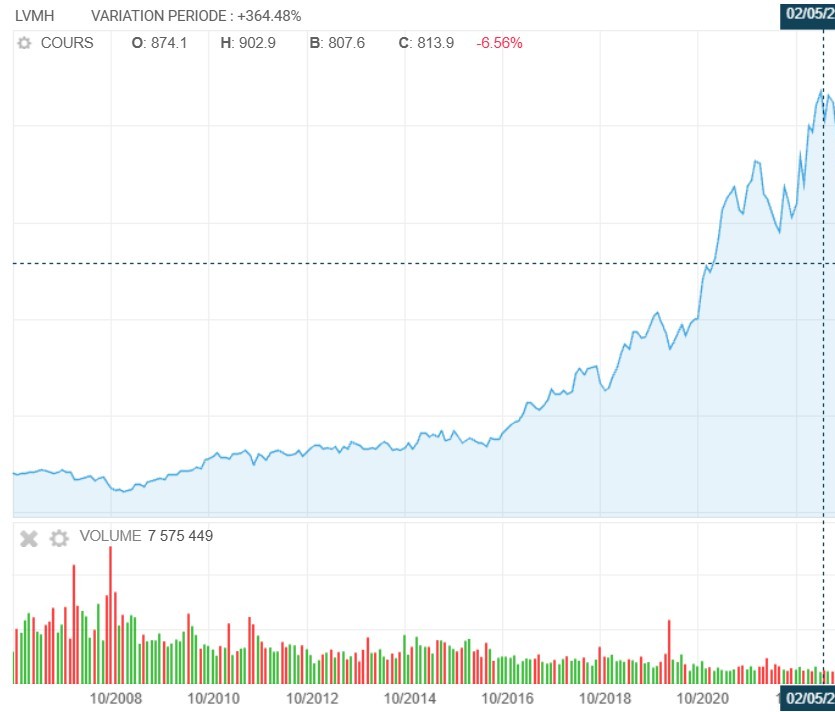
The thing is, I don’t have your crystal ball! Especially when it comes to a quality stock whose share price has followed this curve since 2006 (on the right of these 17 years is 2023, when I made my purchases):

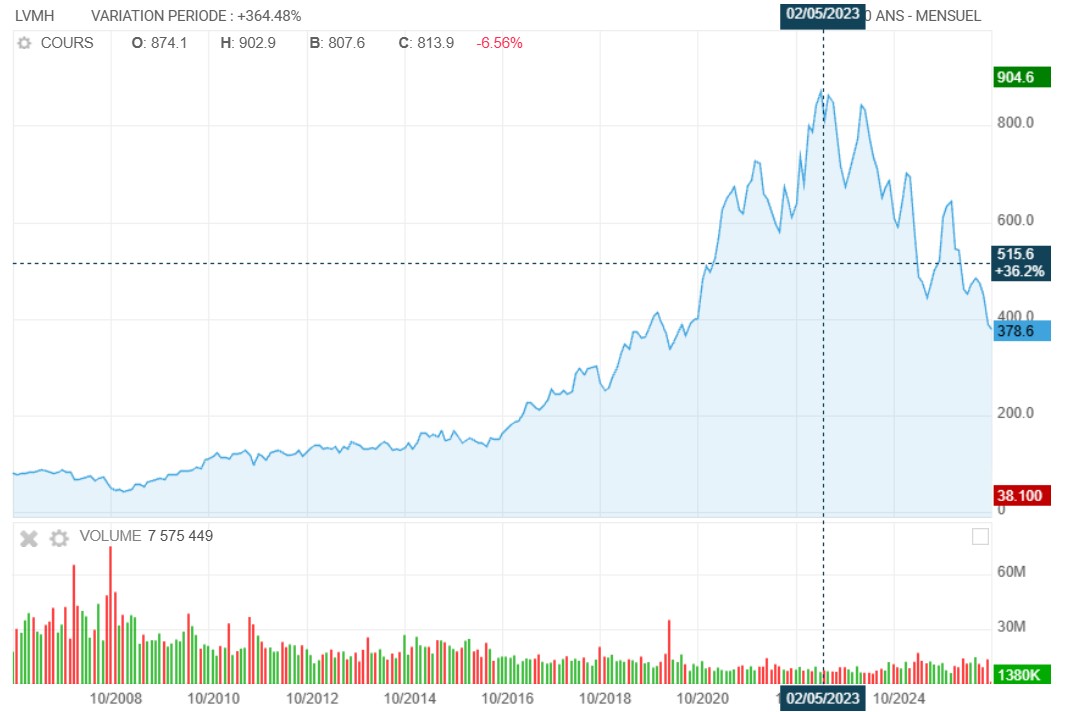
How could I have predicted the downward spiral of the following 3 years (here over 20 years up to 2026):

It’s easy, in hindsight, to compare it to a World ETF and a €2000 DCA. But when you invest long-term in a quality stock that has proven itself and hasn’t disappointed, you don’t sell at the first signs of decline (that’s usually the best way to lose money). You hope that once the current geopolitical uncertainty passes, it will return to its purchase level. But in this case, it didn’t work out… Obviously, if I had known, I wouldn’t have waited so long to sell and above all, I wouldn’t have bought. But I don’t have a crystal ball in my investor’s toolkit.
That’s why I advise young people against stock picking, even though I still have some in my portfolio (a decreasing portion). A World ETF smooths out the roller coaster rides nicely.

3 Likes

… and in the « joys of stock picking » series, under the « don’t sell too soon » section, there are also regrets in the other direction: selling after a few years just before it finally takes off… (this lack of a crystal ball is really annoying, honestly!)

2 Likes

Could you please sell LVMH and Air Liquide quickly so the price goes back up please :sweat_smile:

2 Likes

Selling when it’s falling and buying when it’s rising isn’t the right method, guys

1 Like

:grin: In hindsight, it’s always easy to act smart and say: « yes, you shouldn’t have… » or « you should have done it like this. »

For my part, outside of the PEA where I don’t have much choice, I always buy stocks but only those that are not well represented or not at all in ETFs. But I no longer see them as investments, rather as bets. As a result, they now represent less than 10% of my assets and we spend much calmer weeks…

Now the core of my investments is in global or regional ETFs and when I can’t because such an ETF doesn’t exist, I mix a maximum of 4 or 5 stocks to recreate the same principle, a core and a few satellites with different weightings and it works better that way. The mistake we often make is having too many.

I probably phrased my question poorly, the point of my message wasn’t to compare or boast that it has worked for me so far. I’m very clear-headed about that, that I will also experience this kind of decline. As I said above, I’ve also had my share by cutting my infected units in my life insurance (and taking the loss).

The underlying point of my question is, don’t you set loss limits for yourselves? Knowing that this can be offset by other assets?

Indeed, the idea isn’t to sell at the first decline. But perhaps set a floor, especially if the price struggles to recover afterwards.

The advantage of stock picking is that you can move to another company. Unlike me with my World ETF, if the value drops, it’s better to reinforce and wait for the recovery.

Obviously if it’s out of attachment to the company, that’s another matter. Might as well wait…

I don’t understand the LVMH « hype ». What promise of a future for a company that produces handbags and champagne? Any major innovations?

I’ve never bought stock in this sector.

As a reminder: 5-year performance of LVMH stock: -44%.

Alphabet (Google) performance over the same period: +139%.