Freelance IT, 29 years old, withdraw everything personally (PEA+CTO+AV) rather than invest through my company

Hello everyone,

My profile: 29 years old, in a domestic partnership, freelance in IT, operating as a micro-enterprise with ACRE (active until March 2027). Long investment horizon: 25 to 31 years (target age 55-60).

Monthly savings capacity: approximately €4,000/month currently (ACRE period, until March 2027), then more like €1,500 to €2,700/month once I switch to a company structure (higher costs to withdraw money).

Current assets: I own my apartment (~€450/month all charges/taxes/mortgage included, averaged out), with no other major expenses (no car). Investment-wise: PEA ~€9,640 (contributed €9,535), CTO ~€7,470 mainly in US stocks (Meta, Apple, Alphabet, contributed €3,760, so already substantial unrealized gains), life insurance (Linxea) ~€2,150 (contributed €1,285), and a small crypto position ~€380 (Bitcoin, contributed €205). Total currently invested around €19,600. Freelance revenue around €74,000/year (current assignment abroad).

My objectives: financial freedom / ability to stop working around age 55-60, and incidentally being able to pass on wealth to my loved ones in good conditions.

Risk tolerance: I figure I should take advantage of my long horizon to seek a bit more performance, as long as it remains diversified and not concentrated bets. I’m not against a bit more volatility over the next 10-15 years, before gradually securing things as I approach 55-60.

My main question: My plan is to stay as a micro-enterprise until March 2027 (ACRE), then switch to a company structure (EURL or SASU, not the topic here) while maxing out my PEA (up to the €150,000 cap), then investing in parallel through a personal CTO and life insurance.

An accountant advised me to « think like a business owner » and invest through my company/holding (company CTO, capitalization contract) rather than withdrawing everything personally. My own calculations lead to the opposite conclusion: investing through a CTO held by my company would cost me more, because upon withdrawal (dividend), the flat tax (31.4%) applies to the entire distributed amount (capital + capital gains), not just the gain, unlike the PEA/personal CTO which only taxes the gain.

Hence my two questions:

  1. Is it really worth investing through a CTO or capitalization contract held by the company to « pay less tax, » or is it just deferred tax (therefore roughly neutral, or even unfavorable once you withdraw the money)?
  2. The only real advantage I’ve identified for investing through the company/holding is leveraged real estate (via an SCI). But real estate doesn’t interest me at all as a strategy. Am I still missing something by prioritizing maxing out the PEA then personal CTO/life insurance rather than the company/holding route?

To be honest, this status change is somewhat imposed on me (my current client is pushing me to change structure), and I’m struggling to see how having a company/holding really helps me achieve my goal. I feel like it complicates things without obvious benefit for my situation. Have any of you had the same feeling initially, and what made you change your mind (or not)?

Thanks in advance for your feedback!
Hello Mehdi,

Sorry, I don’t have the expertise to advise you on your future Holding.

Regarding the investment part, I see many contradictions in your message. In your CTO you’re doing stock picking on US tech and the objective you state is to seek performance by diversifying without concentrated bets. On the wrapper you say it yourself, priority to the PEA. And in the same sentence you also say you’re filling an AV and a CTO.

From an outside perspective, I think you’re focusing a bit too much on the wrapper. We should also talk about the securities you’re putting in it.

Sometimes it’s hard to keep things simple, you probably see profiles on this forum with elaborate portfolios. But you need to consider where they are in their investment journey. In short, doing things in order to better optimize your investment is the advice I give you:

  1. Fill the PEA with one or two ETFs (World / EM or ACWI)
  2. Establish a date on an inexpensive AV (that’s done)

Once the PEA is filled, you can focus on contributing to the AV and the CTO. Plus it gives you time to study this CTO on Holding matter…

He definitely forgot to tell you that your investments will bear additional annual taxation throughout their lifetime if you leave them in the holding: whether it’s in a capitalization contract (I’ll let you discover the complexity - and contrary to what the title says, it’s rather unfavorable because the current TME is quite high) or in a brokerage account (for ETFs for example, the general case is that their unrealized capital gain will enter your accounting result, and conversely their capital loss > deficit) - I invite you to look at the various discussions on the forum on this subject because it’s a highly complex topic between stocks, ETFs, ETFs composed of European stocks, there may be other modalities…

So, if your choice is to invest in stocks through the company or invest in stocks yourself directly, and this money is not intended to be reused for your business activity, there’s no contest: withdraw now!

You potentially save years of annual taxation that will eat away at your performance (plus associated accounting fees, etc.). Personally, given the current economic-socio-political context, I would even withdraw the maximum now, the PFU has certainly increased, but it remains an anomaly in French tax history (as a reminder, under Hollande, dividends were included in income tax).

And yet, despite everything I’ve just written, I myself invest in stocks via brokerage account through my holding, why?
Because I want to keep the option to reinject into my business, I want to be able to mobilize cash in case of M&A opportunities (I would also take on debt, of course), I have enough activity in my company to « manage » my result and offset unrealized capital gains (e.g., I’m financing my return to studies)…

I essentially agree with your point 2) the holding is really more interesting for real estate on paper, since roughly speaking you gain 31.4% additional contribution. I would just add a small nuance: credit conditions via SCI are often less favorable than as an individual, with higher or variable rates. There must surely be cases where the trade-off isn’t as obvious as it seems.

It’s essentially therefore a question of capital allocation, if the path of your capital is company > you (which is consistent with freelance activity), then you might as well withdraw, but if the path is much more convoluted, investing through the company is defensible.

1 Like

Hello, thank you for your feedback.

The AV was a few years ago already, just to establish a date. The CTO is also historical, I had started with stock picking a few years ago, but I only fund my PEA with a world emerging ETF now!

Hello and thank you for your message, that confirms my suspicions! Noted in case keeping the money in the company could be useful

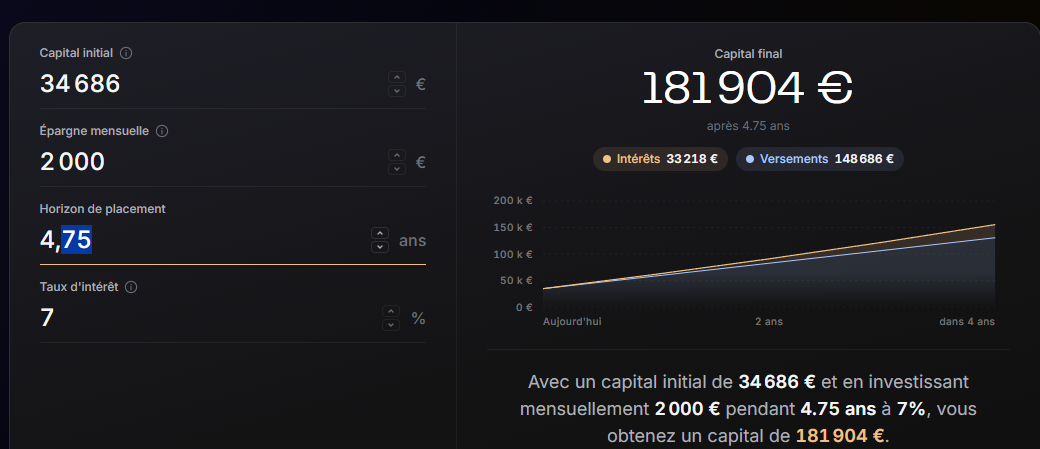
So that’s perfect then. At this rate you can expect to fill your PEA in ~5 years:

4000 € (for 6 months) + ~2000€ for 5 years. It’s a very good investment plan at your age.

Yes, and surely the best… But unfortunately, with my change of status I can invest 50% less with the same revenue…

zootime’s post is a very good summary.

I would just add that I’ve been a freelance IT consultant and I’ve known quite a few. A recurring problem is that accountants tend to push the most complex solutions without caring about the client’s needs. A bit like bank advisors and wealth managers…

I’ve already worked several times with consultants who had a 3-company structure for around 100k€ in revenue « because the accountant said it was better to pay less tax »…

P.S.: for your future choice between EURL and SASU, go look for real feedback on freelance forums (like free-work). Many accountants recommend SASU by default because it gives them more work.

And the « micro salary + dividends » cheat code in SASU has huge disadvantages that become apparent when you read real feedback from freelancers.

1 Like

Hello Mehdi

Are you obliged to stay with this client? Because with 74K and Acre ending in March 2027, that means your micro will be one year old. I would keep the micro status, especially since even if you exceed the threshold (83…K), you can stay in it for 2 calendar years. The client cannot in any way force you to change your structure unless you really want to continue with them. You tell them NO. It’s not in your interest and ask them for the reasons. That’s just my opinion

Good luck with the investments

The client is surely afraid of being convicted for disguised employment given that they are the sole client of this micro-entrepreneur.

That said, depending on the revenue and expenses (including the consideration of meals and part of the home if it’s the registered office), statuses like EURL can be very competitive as well.

But you need to do the calculations carefully and know everything that can be (legally!) deducted.

2 Likes

Hello,

I’m trying to find something else or other missions to complete in the meantime.

Thanks for your response